


Could One Service Visit Add Years to Your Water Heater?

Most people meet their water heater properly on the morning it fails. Until then it sits in a garage corner or a basement closet, filling, heating and refilling thousands of times without anyone giving it a thought.
That habit costs more than it should. A tank or tankless unit that gets looked at once a year tends to run longer, waste less energy and fail on a schedule you can see coming rather than on a cold Monday.
What a visit actually covers varies by home. The crew at plumberanthony.com, based on South Baltimore Street, has job notes that show how wide water heater service in Tacoma can range, from replacing a failed tank with an A. O. Smith unit and adding a recirculation pump so hot water reaches the far bathroom sooner, to retiring an old gas tank in favor of a Rinnai tankless model that needed fresh intake and exhaust lines and a larger gas line to run properly.
The clearest way to understand a good service visit is to follow the water itself, from the moment it enters the heater to the moment it leaves.
Where Cold Water First Meets the Tank
Everything starts at the cold water shutoff above the heater. A technician will turn it to make sure it still closes fully, because a seized valve here turns any future leak into a whole house shutdown.
Next comes pressure. Many homes have a pressure reducing valve near the main, and when one is installed, the plumbing becomes a closed system. Heated water expands, has nowhere to go, and pushes household pressure up every time the burner or element cycles. That is the job of the small expansion tank usually mounted near the heater. Over time its internal air charge leaks down, and a quick tap on the tank tells a lot. A hollow sound near the top is good. A dull thud all the way up often means it has filled with water and stopped doing anything.
A pressure gauge on an outdoor hose bib finishes the picture. Readings much above 80 psi put strain on the heater, the supply connectors and every faucet in the house.
Inside the Tank, Where the Real Aging Happens
Two things wear a storage tank from the inside, and neither is visible from the outside.
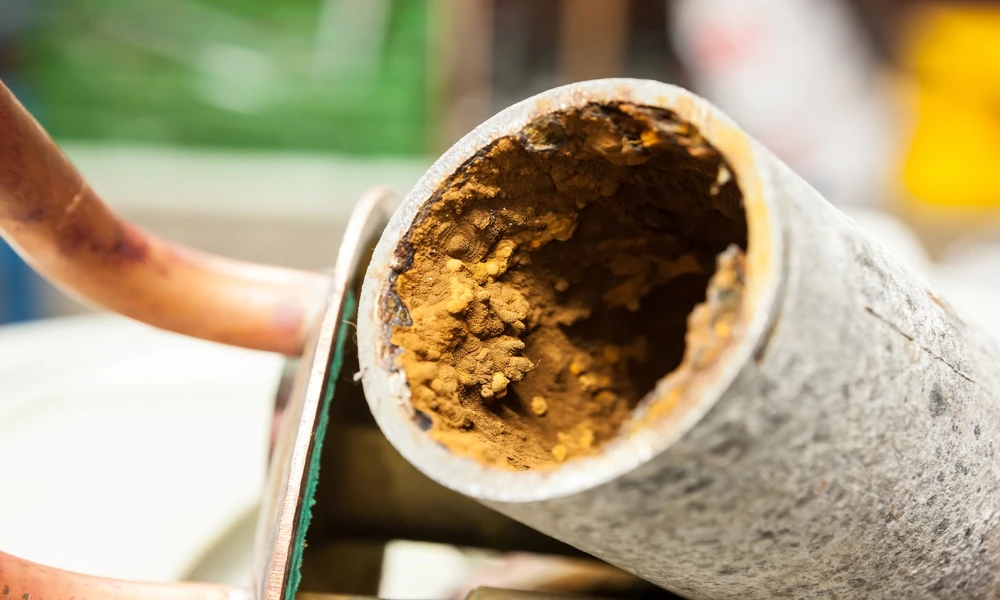
The first is sediment. Minerals and fine debris settle at the bottom, form a crust and force the burner or lower element to heat through it. Tacoma’s water supply runs on the soft side, so homes here usually see less scale than in hard water regions, yet sediment still collects. A flush through the drain valve shows what is down there. Clear water after a minute or two is a good sign, while gritty or rust colored water that keeps coming points to more buildup or corrosion.
The second is the anode rod. This sacrificial metal rod corrodes on purpose so the steel tank does not. Once it is eaten down to its core wire, the tank itself becomes the target. Pulling and checking the rod every few years is one of the cheapest ways to stretch a tank’s life, and replacing a spent one costs far less than a new heater.
The Heat Source Gets Its Own Inspection
What happens here depends on how the unit makes heat.
Gas tanks
The burner flame should be steady and mostly blue. Yellow, lazy flames suggest dirt or poor combustion air. The technician will also check the thermocouple or flame sensor that keeps the gas valve open, and confirm the flue is drawing exhaust up and out instead of letting it spill back near the draft hood. That draft check matters for safety, not just efficiency.
Electric tanks
Most have an upper and a lower element, each with its own thermostat. When hot water runs out much faster than it used to, the lower element is a frequent suspect. A meter test on each element and thermostat usually finds the problem in minutes.
Tankless units
These have no sediment pool, but scale can coat the heat exchanger. Most manufacturers call for periodic descaling with a pump and cleaning solution through the service valves. The small inlet filter screen also needs cleaning, and any stored error codes are worth reading before they become a no hot water call.
The Valve Built to Prevent the Worst Case
Every storage heater carries a temperature and pressure relief valve near the top. If heat or pressure climbs too far, it opens and dumps water through a discharge pipe. Service includes lifting the lever briefly to confirm it moves and reseats. A valve that keeps dripping afterward, or one with mineral crust around the outlet, should be replaced. The discharge pipe itself should run full size, point downward and end where hot water cannot hurt anyone.
How the Heater Is Held in Place
The Puget Sound sits in earthquake country, and a sliding tank can snap a gas line or water connection in seconds. Washington requires water heaters to be strapped, and the details are specific. One Washington city’s water heater installation handout lays out what inspectors expect, with metal straps in the upper and lower thirds of the tank and the lower strap at least four inches above the controls. Older installs held by a single loop of plumber’s tape do not meet that standard.
While looking at the base, a technician will also check for
- rust or moisture around the bottom seam
- a drain pan where a leak could damage finished floors
- clearance between a gas unit and stored paint, solvents or boxes
- flexible connectors that are kinked, corroded or decades old
Where Hot Water Leaves for the House
The last stop is the setting itself. Many households do well around 120 degrees Fahrenheit, which reduces scald risk and standby energy loss. Homes with dishwashers lacking a booster or with specific health needs sometimes run higher, and that is worth discussing rather than guessing.
Long waits at distant fixtures are not always a heater problem. Distance and pipe size play a big part, and a recirculation pump can solve that without changing the heater at all.
Knowing When Service Has Done All It Can
Maintenance has limits. A tank that leaks from the body, not a fitting, cannot be repaired. Units past roughly ten to twelve years with heavy sediment, a depleted anode and rust at the base are usually better replaced on your own timeline. In Washington that replacement normally calls for a permit and inspection, which protects you as much as it adds paperwork.
The point of a yearly visit is not to keep an old heater alive forever. It is to make sure you know where it stands, so the next decision about hot water is one you make calmly instead of one forced on you by a puddle on the floor.
